First, give the film an uninterrupted chance
There is no need to pause every time something looks interesting. On a first viewing, let the film establish its rhythm. Notice when your attention changes: you lean forward, feel unexpectedly distant, become aware of a room or wait for someone to enter. Those reactions are a useful starting point for analysis because they belong to the experience rather than a checklist.
Afterwards, choose one sequence you remember clearly. If you can legally revisit it, watch again with a single question. Trying to track camera movement, costume, sound and editing simultaneously can turn curiosity into clerical work. One precise observation usually teaches you more than a page of general praise about “beautiful cinematography”.
Composition: who gets room to exist?
A frame is a selection. It includes some information and leaves other information out. Ask how much space surrounds a character, whether two people share an image and what sits between them. A doorway, a table or an empty chair can shape a relationship without functioning as a secret symbol that requires decoding.
In Columbus, directed by Kogonada with cinematography by Elisha Christian, built spaces become part of how conversations unfold. Notice the relationship between a person and the larger structure rather than simply admiring symmetry. A balanced image can feel calm, formal or constraining depending on the scene. There is no universal dictionary in which centred composition always means stability.
Try describing an image before interpreting it: “The people stand far apart, with an open doorway between them.” Then ask how that arrangement affects you. Starting with visible evidence makes your response clearer and leaves room for someone else to feel differently.
Light and colour: follow attention, not a formula
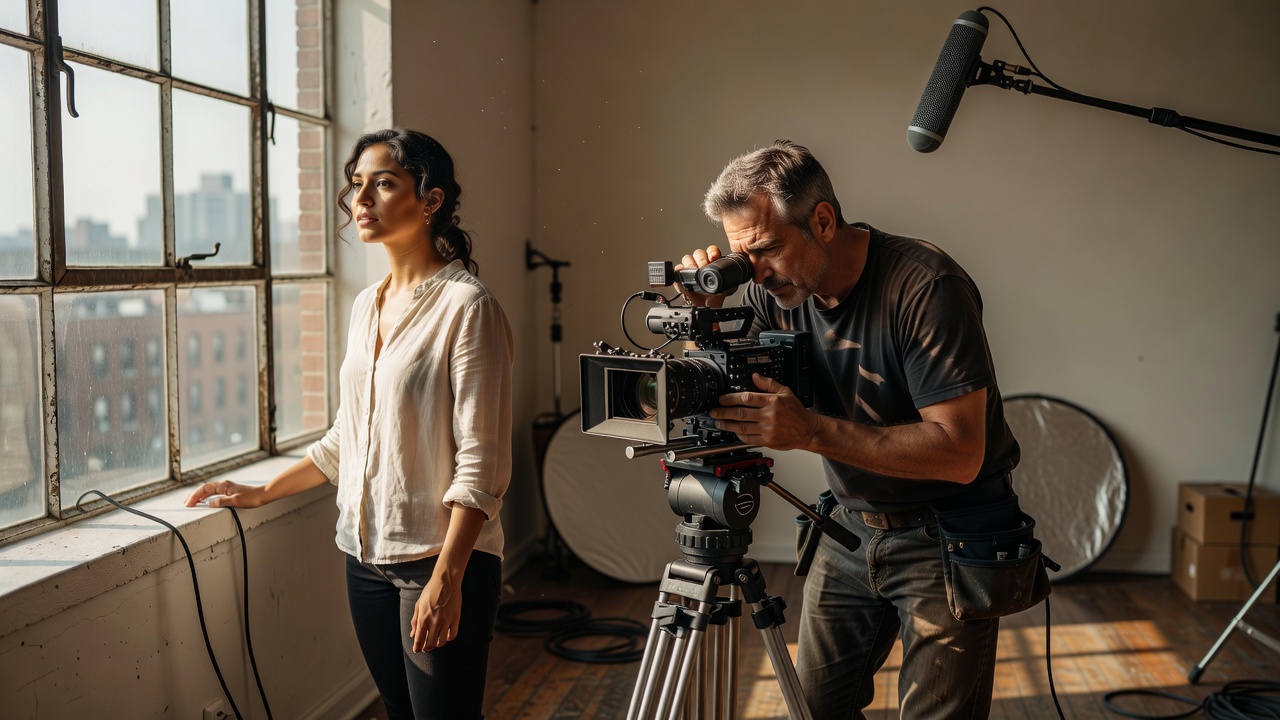
Look for where the brightest area falls and how faces separate from their surroundings. Soft window light may feel intimate, but natural-looking light can require careful design. “Natural” describes an impression, not proof that a crew simply arrived and pressed record. Cinematographers work with exposure, contrast, surfaces and the practical limits of a location.
Colour is similarly contextual. A warm room might feel welcoming in one film and airless in another. Instead of assigning fixed emotions to individual colours, compare adjacent scenes. Has the image become flatter, harsher or less varied? Does a character blend into the room or stand apart from it? Those relationships are often more revealing than a single striking hue.
The question is not “Did I decode it correctly?” It is “What did this choice make possible?”
Movement and duration: how does the film spend time?
A camera can follow a person, wait for them or refuse to give us their face. Each creates a different relationship with the viewer. Handheld movement does not automatically mean realism, just as a locked-off shot does not automatically mean emotional distance. Look at what the approach allows you to notice and what it makes difficult to see.
Duration matters too. A shot held beyond the expected moment can invite reflection, create discomfort or reveal another action within the frame. In Kelly Reichardt’s work, practical tasks often retain enough duration for effort to register. The time is not necessarily a pause in the story; the effort may be the story’s immediate concern.
Then consider the cut. Does it arrive when you anticipate it, or leave you briefly searching? Editing creates relationships across images as well as pace within a scene. A brisk sequence can still feel emotionally suspended, while an extended shot can contain enormous change. Count cuts only if counting helps answer a real question.
Sound: listen beyond the dialogue
Cinematography does not operate in isolation. In Anna Rose Holmer’s The Fits, bodily rhythm and the sounds of shared spaces contribute to the sense of attraction and unease. Ask which noises come forward, which recede and whether you can hear something before seeing its source. Off-screen sound can make a small visible space feel connected to a larger world.
Silence is rarely the literal absence of sound. A room may contain ventilation, traffic, clothing or distant voices. When music stops, those textures can suddenly become noticeable. If accessibility requires captions or subtitles, use them; the goal is an available viewing experience, not a test of unaided perception.
A small exercise for your next screening
Choose one ordinary exchange and remember three things: the distance between people, the moment the image changes and the loudest non-dialogue sound. Afterwards, explain how those choices shaped your feeling in plain language. You have made a useful piece of film analysis without needing to identify a lens or guess an equipment package.
The best result is not watching every film from a permanent analytical distance. It is gaining another way back into the pleasure: noticing how a seemingly simple moment was made to feel so specific.